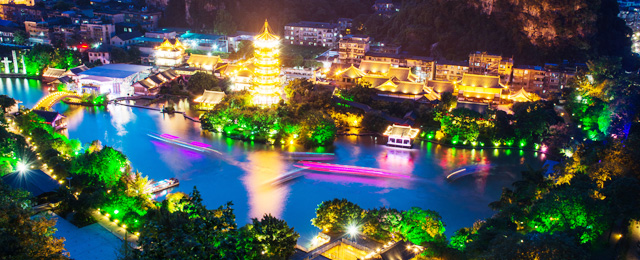
Two Rivers and Four Lakes Scenic Area
Known as the business card of Guilin, the Two Rivers and Four Lakes refer to the city's ring water system composed of Rong Lake, Shan Lake, Gui Lake, Mulong Lake, Li River, and Taohua River. This water system connects the most beautiful ring-city scenery in the center of Guilin. Taking a nighttime boat tour is the best way to experience it!
Shan Lake Overview
Shan Lake lies to the east of Yang Bridge in downtown Guilin. Its water body connects with Rong Lake. Both are remnants of the moat south of the city dating back to the Tang and Song dynasties. The lake was incorporated within the city boundary in the Ming Dynasty and got its name for the abundant fir trees growing along its banks. In the Qing Dynasty, the “Ten Scholars of Shan Lake” composed and exchanged poems at Bushan Tower by the lake. Relief carvings preserved today record this cultural legacy, marking the site as a famed gathering place for literati in history. Rising at the lake‑centre are Sun‑Moon Twin Pagodas, an urban landmark. The Sun Pagoda is entirely cast in copper and known as the world’s tallest copper pagoda built over water. The Moon Pagoda is decorated with glazed tiles. The two pagodas are linked by an underwater passage. At night, brilliant lights illuminate the structures, whose reflections stretch across the water — a classic night‑view highlight of Two Rivers and Four Lakes. Surrounded by the Li River Waterfall Hotel, Zhengyang Pedestrian Street and the Official Residence of Li Zongren, the lake blends urban bustle with natural mountain‑river scenery, and the site is open to visitors free of charge.
Rong Lake Overview
Rong Lake is situated to the west of Yang Bridge in downtown Guilin and serves as a core lake area of the urban circular water system of Two Rivers and Four Lakes. It functioned as the southern city moat during the Tang and Song dynasties. After the city was expanded in the Ming Dynasty, it evolved into an inner lake within the city. Formerly known as Jian Lake and Yangtang, it got its name from the Thousand year old Banyan Tree growing on its north bank. When Huang Tingjian passed through Guilin in the Northern Song Dynasty, he moored his boat here and composed celebrated poems extolling Guilin’s landscapes, endowing the area with profound humanistic heritage.
The lake area features a cluster of scenic spots including Ancient South City Gate, Big Dipper Bridge, Glass Bridge, Rongxi Bridge and Central Lake Island. Boasting an expansive water surface dotted with pavilions and terraces, the lake is encircled by serene walking trails. It is ideal for strolling in daytime. At night, shimmering lights reflect on the water, forming an elegant picturesque scene that fully embodies the charm of “a city nested in scenery, with scenery woven into the city”. The lake area is open to visitors free of charge.
Gui Lake Overview
Gui Lake is a remnant of the western city moat of Guilin dating back to the Song Dynasty, commonly known as Xihaotang. Stretching nearly 1,700 metres from north to south, it is the largest of the Four Lakes. Backed by Old Man Hill and Baoji Hill, the lake presents a delightful interplay of mountains and waters. Following the Two Rivers and Four Lakes renovation project, it has been developed into a garden belt integrating famous trees, themed gardens and landmark bridges. Along the lake lie themed gardens including Metasequoia and Ginkgo. The lake is spanned by scenic bridges such as Lize, Baoxian and Guanyi. In autumn, sweet osmanthus fragrance fills the whole garden. Visitors can enjoy both strolling along the comfortable lakeside trails and boating on the lake. At night, Gui Lake Fishing Lights Show and “Red Sails of Gui Lake” showcase traditional fishing customs. Lush green woods thrive by day, while lamplight shimmers on the water after dark. The lake area is open to visitors free of charge.
Mulong Lake Overview
Mulong Lake sits at the northernmost end of the urban circular water system of Two Rivers and Four Lakes. It is bordered by Diecai Hill to the south, and Tiefeng Hill and Dongzhen Gate to the north. The lake was artificially excavated to connect the inner lake waterways with the Li River navigation channel and takes its name from the nearby Mulong Cave. This area served as military barracks for Jingjiang Prefecture’s city defence in the Song Dynasty. Dongzhen Gate and Song Dynasty City Wall Ruins survive to this day as rare tangible relics of a complete Song Dynasty city in Guilin. Centered on Song Dynasty culture, the scenic area features Mulong Pagoda and the antique style Song Street complex built in accordance with Song Dynasty architectural styles, recreating the appearance of the ancient prefectural city. It also serves as a key navigation node for inner lake cruises heading to the Li River. Natural mountain river scenery, well preserved Song Dynasty city wall remnants and Song style architecture merge as one. Set off by the mountain views of Diecai Hill, the site offers visitors an immersive sense of history. Tickets are required for entry into the core zone of Mulong Lake, where visitors can view the historical Song Dynasty city walls and immerse themselves in ancient Song Dynasty culture.